
ECG Electrodes Bulk Supply: A Clinical Buying Guide for 2026
10/09/2026 05:11:48

The largest ECG electrode order isn’t always the best prepared. With ECG electrodes bulk supply, a mismatch in connector or electrode design can leave you with stock that doesn’t suit your monitors, patients, or procedures. Ordering too much or too little can also complicate routine replenishment.
Pack size matters, but clinical fit and day-to-day use should come first. Use this guide to match electrodes to your equipment and workflow, then plan orders around actual consumption and product storage instructions. Compare intended use, connector, material, quantity, expiration information, and storage requirements without assuming compatibility. Whether you’re purchasing for routine ECGs or ongoing monitoring, a consistent process helps you compare options and plan a more informed order. USA Medical and Surgical Supplies offers ECG electrodes through its online storefront, where product listings support your evaluation.
Key Takeaways
- Start ECG electrodes bulk supply planning with procedure volume, patient mix, and equipment, not pack size alone.
- Use a consistent checklist to compare each electrode’s intended use, connector, dimensions, material, and application with device documentation.
- Compare product listings by practical attributes, including format and stated patient group, before narrowing your options.
- Estimate purchasing needs from your own usage records, account for schedule changes, and set a regular replenishment review.
- Review quantity, expiration information, storage instructions, and stock rotation as part of purchasing.
ECG Electrodes Bulk Supply: Start with the Clinical Workflow
ECG electrodes are patient-contact components that detect electrical signals from the body so an electrocardiogram (ECG) can record cardiac activity. Choose electrodes by matching their stated intended use and monitor compatibility to the procedure, patient group, and duration of use. That’s a more useful starting point than choosing the largest pack or the lowest unit cost.
Before planning ECG electrodes bulk supply, map how your team uses them. A clinic performing scheduled resting ECGs has different purchasing considerations from a service that also supports cardiac monitoring or stress testing. List the equipment in use, the procedures performed, and the patient groups served. Then identify which product details matter for each workflow. A larger order makes sense only when the electrodes suit that work and can be stored and rotated appropriately.
Which clinical settings use ECG electrodes?
ECG electrodes are used in routine resting ECGs and cardiac monitoring, among other settings. Procedures can differ in how electrodes connect to equipment and how long they need to remain in use. Those differences affect which listed attributes to prioritize, such as intended application, connector, electrode format, material, or stated patient group.
For example, a purchasing team supporting both brief diagnostic tests and longer monitoring should compare products against each use case rather than treat them as interchangeable. Start with equipment and procedure documentation. Don’t assume that electrodes with a similar appearance share the same connector or application. The overview of Electrocardiography explains the broader role of electrodes in recording electrical activity. This section focuses on procurement, not lead placement; placement should follow the relevant clinical instructions.
What does bulk supply mean for a clinical purchaser?
Bulk purchasing means setting an order quantity that fits observed consumption and a planned replenishment cadence. It doesn’t automatically mean buying a particular case size or meeting a presumed order threshold. Pack quantity and purchasing need are separate questions: first estimate how quickly your team uses electrodes, then compare available listing quantities with that forecast.
Use inventory records to track usage and remaining stock. Include routine demand and known schedule changes in your estimate, then set a review interval that gives your team time to reorder before supplies run low. Your own consumption history is more useful than an unsupported industry average.
Plan storage and stock rotation alongside purchasing. Follow the manufacturer’s storage instructions, record expiration details where provided, and organize stock so older suitable inventory is used first. These steps help prevent a bulk order from becoming excess or unusable stock. The goal is a repeatable process: match electrodes to clinical use and equipment, order against actual consumption, and review inventory on a regular schedule.
How to Select Bulk ECG Electrodes for Equipment and Patient Needs
A reliable selection process checks the electrode against both the ECG device and the clinical task. For ECG electrodes bulk supply, apply the same criteria to each option before comparing order quantities. A familiar-looking connector or a broad product description doesn’t establish fit on its own.
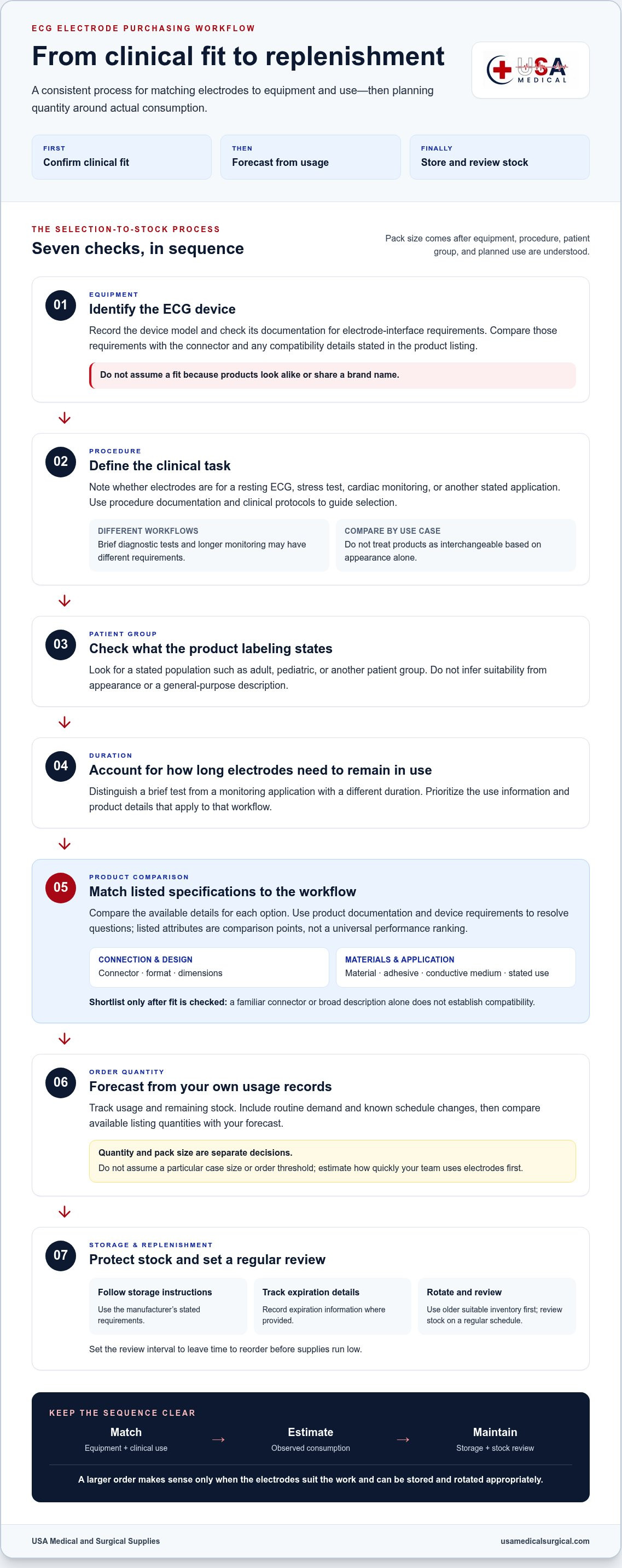
Compatibility depends on matching electrode specifications with device documentation, then confirming that the stated intended use fits the patient group and procedure. Work through this checklist before shortlisting products:
- Identify the ECG device. Record the device model and locate its documentation, including any stated requirements for the electrode interface.
- Define the procedure. Note whether the electrodes are for a resting ECG, stress test, or another stated application. Use the procedure documentation and clinical protocols to guide selection.
- Identify the patient group. Check whether the product labeling states adult, pediatric, or another patient population. Don’t infer suitability from appearance or a general-purpose description.
- Consider use duration. Distinguish a brief test from a monitoring application with a different duration. Prioritize the use information and product details relevant to that workflow.
Check device compatibility before comparing quantities
Start with the ECG device model, then find the electrode interface requirements in its documentation. Compare those requirements with the connector and any stated device compatibility in the product listing. Don’t assume products fit because they share a brand name or look alike. For context on comparing ECG devices, use this ECG machine buying guide alongside the documentation for the equipment already in use.
Match electrode design to intended use
Compare the listed electrode format, dimensions, material, adhesive, conductive medium, and application wherever those details are provided. These attributes help distinguish options, but they don’t establish a universal performance ranking. Suitability depends on the product’s stated intended use and the requirements of the specific procedure and clinical protocol.
Pay close attention to labeling for adult, pediatric, and specialty applications. A product description that doesn’t state the patient group shouldn’t be treated as proof that it suits every population. Similarly, don’t assume that a design used for one procedure is appropriate for another procedure or monitoring duration. Use product documentation and clinical protocols to resolve those distinctions.
Keep a simple comparison record for shortlisted options: device model, connector, dimensions, material, intended application, stated patient group, and use duration. This makes it easier to spot a mismatch before comparing pack quantities. Base important decisions on product information and equipment documentation rather than assumptions.
Once your criteria are clear, browse the ECG electrode options and compare their listed details with your checklist. This keeps your evaluation tied to your equipment and workflow before you decide how much to order.
Compare ECG Electrode Types Without Buying on Pack Size Alone
Once you’ve confirmed the clinical task and equipment requirements, compare product listings using the same attributes. A structured review helps separate meaningful differences from pack size. Quantity matters after you’ve established that an option suits the intended use and estimated how quickly your team will use it.
Use listing and manufacturer information as your evidence. Adhesive, conductive medium, and other material details can help distinguish products, but don’t assume that a particular material guarantees comfort, signal quality, or suitability. Those conclusions depend on product specifications and the applicable clinical protocol.
Compare the specifications that affect day-to-day use
Product format and stated application can affect how electrodes fit into a routine, from opening and handling to matching supplies with a particular procedure. Record the details the manufacturer provides. This guide compares purchasing criteria, not the clinical effectiveness of specific products.
| Listing attribute | What to compare | Why it matters to purchasing |
|---|---|---|
| Intended use | Stated application or procedure | Helps distinguish products intended for different workflows. |
| Connector | Connector description and any stated device compatibility | Supports comparison with equipment documentation before ordering. |
| Electrode format | Described form, dimensions, or design | Can inform handling and whether the listed format fits the intended workflow. |
| Patient group | Stated adult, pediatric, or specialty application | Prevents assumptions based on appearance or broad product descriptions. |
If material or conductive-medium information is included, capture it in your comparison record and treat it as a product description, not a performance promise. If a detail isn’t stated, don’t fill the gap with an assumption. Keep the comparison tied to information in the listing and relevant product documentation.
Compare disposable and reusable options at the right level
Disposable and reusable electrodes are different purchasing and handling categories. Check the product labeling to identify which applies, then follow the stated use instructions and relevant clinical protocols. Reusable products may have reprocessing requirements; follow the manufacturer’s directions and applicable protocols rather than assuming a method or cycle.
A full workflow and safety comparison is beyond this buying-criteria overview. For this decision, record the product category and its stated requirements, then assess how those requirements fit your setting.
For ECG electrodes bulk supply, compare quantity only after the product passes the fit review. A larger pack may seem convenient, but it isn’t practical if its listed application, connector, or patient group doesn’t match your needs. Estimate use from your own records, then compare pack quantities among options that meet the clinical and equipment criteria. This sequence keeps purchasing decisions grounded in suitability and actual consumption.
Plan ECG Electrode Quantities, Storage, and Replenishment
A practical ordering plan starts with your own usage records, not an assumed industry average or a supplier’s pack size. For ECG electrodes bulk supply, estimate demand over your usual replenishment period, account for expected changes, then decide when inventory should trigger a reorder. This connects purchasing quantity to how your practice operates.
Estimate a practical order quantity
Review recent issue or consumption records to establish typical weekly use. Multiply that rate across the period your practice normally plans between orders. Treat the result as a working estimate, not a fixed requirement: scheduled services, staffing changes, procedure volumes, and other expected fluctuations may shift demand. Update the estimate when usage patterns change.
Set a reorder point using your own lead-time data and inventory policy. Begin replenishment while enough usable stock remains to cover expected demand during the ordering period. Don’t build the calculation around an assumed pack size. First determine the quantity your workflow requires, then compare that need with the quantities shown in product listings.
A simple review can track:
- Recent weekly consumption for each electrode type used.
- Expected schedule or staffing changes that could affect demand.
- Current usable inventory, including expiration information.
- Your practice’s ordering lead-time records and reorder threshold.
Review the forecast at a consistent interval. Regular checks help identify changes early, such as a shift in procedure volume or a product type being used faster than expected. Keep separate records for different electrode types when their intended uses or workflows differ, so remaining stock in one category doesn’t obscure a shortage in another.
Protect stock quality during storage
Storage requirements and expiration information can vary by product. Follow the manufacturer’s instructions for each item rather than applying a single storage rule or assuming a universal shelf life. Include those details in your inventory process before placing a larger order, so expected usage and product-specific limits can be considered together.
Organize stock so staff can identify the electrode type, lot information, and expiration date. Use a first-expiring, first-out rotation: place newly received stock behind earlier-expiring stock of the same appropriate type, then select the earlier-expiring suitable stock first. Keep products in their specified storage conditions and retain identifying information so inventory checks can be completed consistently.
When reviewing ECG electrode options, compare the listed quantity with your forecast and the product’s expiration and storage details. A pack that exceeds expected use may occupy storage and complicate rotation; one that falls short may require more frequent replenishment. The right balance depends on actual consumption and product instructions, not pack size alone.
Use your forecast and rotation plan to guide your next purchase. Browse ECG electrodes and compare listed product details with your inventory needs before ordering.
Source ECG Electrodes Through USA Medical and Surgical Supplies
USA Medical and Surgical Supplies offers ECG electrodes through its online medical supply catalog. Use the product information to complete your purchasing review before selecting an option. Connect the electrode’s stated application and device requirements with your procedure schedule and inventory plan rather than choosing on quantity alone.
Use a final purchasing checklist
Before placing an order, compare product details with your clinical requirements and equipment documentation. A short, consistent checklist helps purchasing staff assess options using the same criteria and makes the decision easier to review later.
- Intended use: Confirm the application stated in the product information and whether the stated patient group fits your use.
- Device compatibility: Compare the connector and any listed compatibility details with the ECG device documentation. Don’t infer fit from brand or appearance.
- Product details: Review listed dimensions, format, material, and conductive-medium information where provided. Use manufacturer descriptions rather than assumptions about performance.
- Order quantity: Compare the quantity shown with your usage forecast and replenishment cadence. Decide this after determining that the product meets your selection criteria.
- Storage and rotation: Review the manufacturer’s storage directions and expiration information, then plan how staff will identify and rotate stock.
These checks keep selection and ordering connected. Use the listing and applicable device or manufacturer documentation when a product detail is central to your decision. Record the option selected and why it fits your intended workflow. That record can help when reviewing inventory or reassessing electrode needs after procedures or schedules change.
Browse the ECG electrode category
Once your requirements are clear, use the online catalog to compare ECG electrode options and their listed details. Keep the device model, intended application, patient group, and quantity forecast available as you review. This helps you focus on information relevant to your practice without relying on assumptions about a product’s specifications or pack size.
After ordering, continue the inventory process you established. Track use, review stock at your planned interval, and rotate items according to their expiration information and manufacturer storage instructions. A purchase completes one step in the supply plan; ongoing records help inform the next one.
To compare options against your final checklist, shop ECG electrodes through the online catalog.
Make Your Next Electrode Order More Deliberate
A dependable purchasing process should be easy to repeat and simple to adjust. Treat each order as a chance to refine your records: note what your team uses, flag workflow changes, and revisit your purchasing criteria when equipment or procedures change. That keeps ECG electrodes bulk supply decisions grounded in current needs instead of habit.
USA Medical and Surgical Supplies carries ECG electrodes in its online medical supply catalog, with online ordering for customers throughout the United States. Review product listings alongside your equipment documentation and inventory plan. A clear, consistent review makes the next purchasing decision more straightforward.
Browse ECG electrodes and take the next step toward a supply process that fits your clinical workflow.
Frequently Asked Questions
How many electrodes are used for a standard 12-lead ECG?
A standard 12-lead ECG typically uses 10 electrodes: four limb electrodes and six chest electrodes. The “12-lead” count refers to the electrical views recorded, not the number of electrode pads attached. Equipment configurations and clinical protocols can vary, so use the device instructions and established procedure guidance for your setting. Keep electrode count distinct from lead count when forecasting supplies for routine tests.
Do ECG electrodes expire?
Yes. ECG electrodes can have a manufacturer-stated expiration date, which may differ by product. Check the date on the package rather than estimating shelf life from when the order arrived or whether the package remains unopened. If stock is expired, separate it from usable inventory and follow your facility’s process for handling it. Record expiration dates during receiving so staff can identify stock that needs review.
How should unopened ECG electrodes be stored?
Store unopened electrodes according to the manufacturer’s instructions for that specific product. Keep them in their original packaging so staff can refer to the product label, lot information, and expiration date. Don’t assume all electrodes share the same temperature, humidity, or light requirements. During routine inventory checks, inspect packaging for damage and confirm that storage conditions have remained within the manufacturer’s stated guidance.
Can ECG electrodes be used on pediatric patients?
Some ECG electrodes are intended for pediatric patients, but suitability depends on the product’s labeling and the clinical protocol. Check that the stated patient group matches the intended use; don’t infer pediatric suitability from a product’s size or general description alone. A practice serving both adults and children can keep distinct inventory records for products with different labeled patient groups to reduce selection errors.
Can disposable ECG electrodes be reused?
No. An electrode labeled for single use or as disposable shouldn’t be reused. Follow its labeling and your facility’s procedures for disposal after use. Reusable electrodes are a separate product category and should only be used and reprocessed according to their manufacturer instructions and applicable clinical protocols. Don’t treat a disposable electrode as reusable because it looks intact or appears to have unused adhesive.
What information should I record when tracking ECG electrode inventory?
For ECG electrodes bulk supply, record enough detail to distinguish products and trace stock: product identifier, electrode type, lot information, expiration date, quantity received, quantity on hand, and storage location. Add dates for stock counts and note usage or adjustments so discrepancies can be investigated. If a count differs from the expected balance, staff can review recent issues and receipts before changing the reorder record.