
Handheld Vascular Doppler: 2026 Clinical Buying Guide
09/27/2026 21:07:44
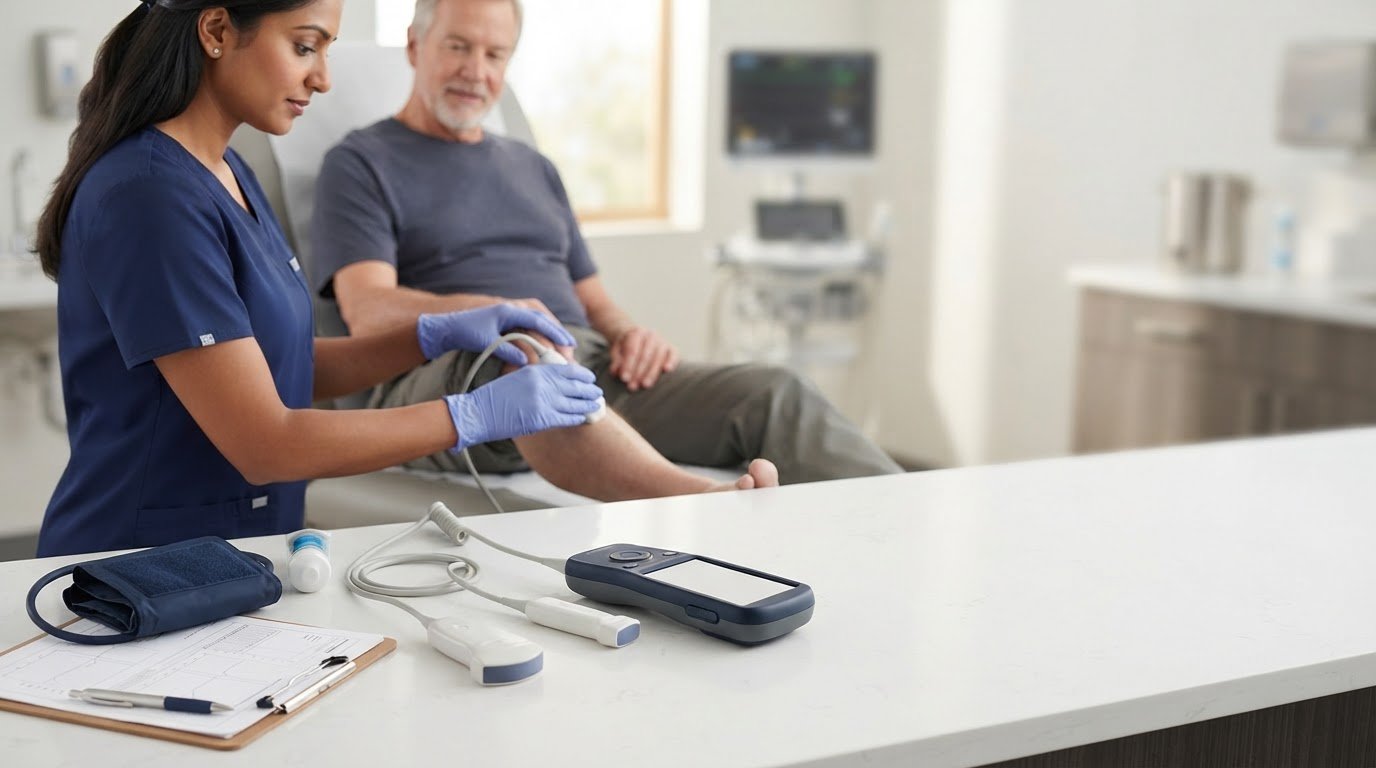
Probe frequency can matter more than price when you’re choosing a handheld doppler for vascular assessment. It’s easy to get caught between 4 MHz and 8 MHz options, or to mistake a fetal Doppler for a clinical vascular unit. Start by matching the device to the vessels you assess and the exams your practice performs.
Clear audio helps clinicians assess blood-flow signals, while a suitable build and practical controls matter in a busy clinical setting. Probe selection also affects usability: 8 MHz probes are generally used for superficial vessels, while 4 to 5 MHz probes offer greater penetration for deeper vessels.
This guide explains how to compare probe frequencies and features, distinguish vascular equipment from fetal Dopplers, and consider training and measurement technique in an ABI workflow. Use these criteria to narrow your choices to a device that suits your care setting and the assessments your team performs.
Key Takeaways
- Match your handheld doppler for vascular assessment to the vessels and exams in your practice, rather than choosing by price alone.
- Assess audio clarity and display options to determine how well a device supports flow assessment and clinical documentation.
- Pair Doppler use with an appropriate blood pressure cuff and a consistent ABI workflow to support PAD screening.
- Review durability and practical features for your clinical workload before selecting a unit.
- Consider consolidating Dopplers, blood pressure devices, and ECG equipment through a medical distributor to simplify practice procurement.
The Role of Handheld Dopplers in Vascular Assessment
A handheld vascular Doppler uses ultrasound to detect blood flow and assess its velocity. It works by detecting frequency shifts as sound waves reflect off moving blood cells. The basic principle is explained in this overview of Doppler ultrasonography. In clinical practice, the device can help clinicians assess arterial pulses and blood-flow patterns as part of an evaluation for Peripheral Artery Disease (PAD) or venous conditions such as venous insufficiency.
A Doppler finding is one part of an assessment, not a diagnosis on its own. Clinicians interpret the signal alongside the patient’s history, examination, and other appropriate tests. For example, a handheld unit can help locate a pedal pulse or obtain pressure readings during an Ankle-Brachial Index (ABI) assessment. Its portability can make it useful for an in-room check without setting up a full ultrasound cart. It can also support pulse assessment for patients with diabetes or hypertension when their clinical picture calls for closer vascular evaluation.
Why Handheld Units Are Essential for Modern Clinics
Portability makes a handheld Doppler practical for bedside checks and primary care or podiatry workflows. Staff can bring it to the patient, check whether a pulse is detectable, and continue the assessment without setting up a larger imaging system. For routine screening tasks, this may be more practical than relying on a cart-based ultrasound system. A handheld unit does not replace comprehensive vascular imaging when that is indicated.
Vascular Assessment vs. Fetal Tracking
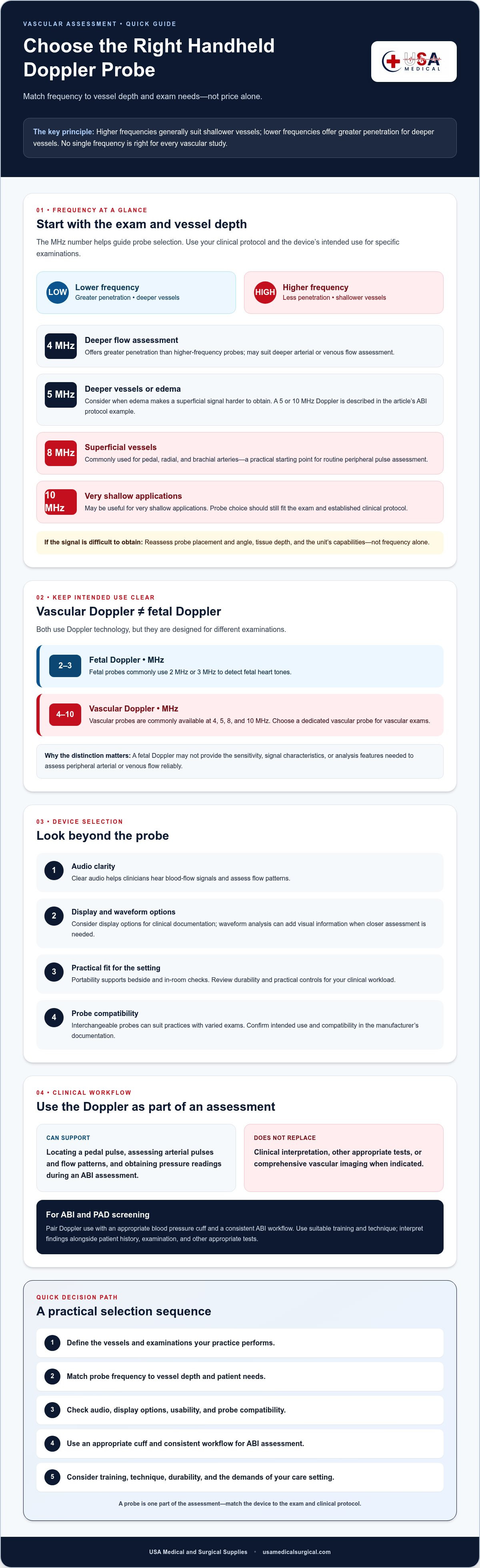
Vascular and fetal Dopplers use the same Doppler technology, but they are designed for different examinations. Fetal probes commonly use 2 MHz or 3 MHz frequencies to detect fetal heart tones. Vascular probes are commonly available at 4, 5, 8, and 10 MHz. Higher frequencies are generally suited to shallower vessels, while lower frequencies offer greater penetration. Probe design and sensitivity also affect how effectively a device detects the flow signal being assessed.
A fetal Doppler is not a substitute for a dedicated vascular unit. Its probe and intended use may not provide the sensitivity, signal characteristics, or analysis features needed to assess peripheral arterial or venous flow reliably. Using it for vascular exams can produce a signal that is difficult to interpret and may not support appropriate clinical measurements. Choose a professional handheld doppler for vascular assessment with a dedicated vascular probe. Clear audio helps clinicians hear flow patterns, and models with waveform analysis can add visual information when documentation or closer assessment is needed. Match the device to the exam, and use appropriate training and technique.
Selecting the Correct Probe Frequency (MHz) for Clinical Exams
Probe frequency affects how deeply ultrasound can travel through tissue. In general, higher frequencies provide more detail for shallow structures but penetrate less deeply. Lower frequencies travel farther into tissue, which can help when assessing deeper vessels or limbs with substantial edema. The right choice depends on the vessel, patient, and examination. No single frequency is right for every vascular study.
Probe Frequency Selection Guide
- 8 MHz: Commonly used for superficial vessels, including pedal, radial, and brachial arteries. It’s a practical starting point for routine peripheral pulse assessment.
- 5 MHz: Consider for deeper vessels or when edema makes a superficial signal harder to obtain. Stanford Medicine’s Stanford Medicine ABI protocol describes using a 5 or 10 MHz Doppler for ABI measurements, illustrating that probe choice should fit the exam.
- 4 MHz: Offers greater penetration than higher-frequency probes and may suit deeper arterial or venous flow assessment. Follow the device’s intended use and your clinical protocol for specific exams, including suspected deep vein thrombosis (DVT).
These are practical selection guidelines, not a substitute for an established clinical protocol. A 10 MHz probe may also be useful for very shallow applications. If a signal is difficult to obtain, reassess probe placement and angle, tissue depth, and the unit’s capabilities instead of assuming frequency is the only issue.
Interchangeable or Fixed-Probe Systems?
Interchangeable probes can offer flexibility for a practice that performs different types of examinations. Confirm that each probe is designed for the intended exam and is compatible with the specific Doppler unit. Similar-looking connectors do not guarantee compatibility, so check the manufacturer’s documentation before ordering. Clinics that primarily perform vascular exams may prefer a dedicated vascular configuration to keep routine setup straightforward.
Fixed-probe designs reduce the need to change probes during use. Weigh that convenience against how the unit will be handled in a high-volume setting. Review the probe cable, connector, housing, and storage requirements. Also consider how staff will clean and protect the equipment between examinations, since these details affect everyday readiness.
Before selecting a handheld doppler for vascular assessment, list the probes required for your common exams and patient needs. Practices that also assess fetal heart tones should verify whether a unit supports the appropriate separate probe. Do not assume a vascular probe can serve both purposes. Compare professional vascular Dopplers by probe options, intended use, and compatibility to find a configuration that fits your workflow.
Essential Features: Audio Quality, Display Options, and Portability
Sound is central to using a handheld Doppler for vascular assessment. Clear, stable audio helps the clinician hear changes in the blood-flow signal and assess whether it has a broadly monophasic, biphasic, or triphasic character. Ambient noise, movement, and poor speaker quality can make those differences harder to hear. Interpret sound patterns in context, since audio alone does not establish a diagnosis.
Audio Fidelity and Noise Reduction
Assess audio in conditions similar to those in your clinic, not only in a quiet room. Check whether the unit offers noise reduction and whether it preserves useful flow signals rather than making them harder to distinguish. A built-in speaker allows shared listening during an exam. A headphone jack may help clinicians focus in a noisy room or conduct a more private assessment. Listen for a clear flow signal rather than relying on volume alone.
Terms such as “whooshing” or “clicking” can help describe what is heard, but they are not substitutes for consistent examination technique or clinical interpretation. Check whether staff can adjust the volume easily and reach the controls while positioning the probe.
Display and Documentation Options
Some units provide a pulse-rate display, while others show a waveform. A rate readout gives a numerical reference; a bi-directional waveform can show flow direction and provide a visual record of the signal. That information may help with closer assessment and charting, but it does not automatically improve accuracy. Consider what your exam requires and whether the display is clear enough to interpret.
If documentation matters, verify the device’s actual storage and transfer functions. Internal memory or PC connectivity may support recordkeeping, but do not assume compatibility with your electronic medical record (EMR). Confirm file formats, transfer steps, and software requirements before purchase. Check screen contrast and readability under the lighting conditions where staff will use the unit.
Portability, Power, and Cleaning
A portable unit is useful only if it is ready when needed. Compare rechargeable batteries with replaceable options based on your clinic’s charging routine, expected use, and access to replacements. Review battery indicators and charging requirements to help avoid interruptions during a busy schedule.
For infection control, review the transducer’s surface and the manufacturer’s cleaning instructions. Do not assume the probe or unit is waterproof. Confirm whether each can tolerate the cleaning products and methods used in your facility. Choose a handheld doppler for vascular assessment with features that fit the actual workflow, including clear audio, an appropriate display, practical power management, and surfaces staff can clean according to instructions.
Clinical Workflow: Integrating Dopplers into ABI and PAD Screening
A manual Ankle-Brachial Index (ABI) pairs a handheld Doppler with a blood pressure cuff to compare systolic pressure at the ankle with pressure at the arm. Consistent positioning, signal acquisition, and recording matter. Follow your facility’s protocol and staff training, and interpret the result alongside the patient’s overall clinical picture.
Step-by-Step Manual ABI Assessment
- Position the patient. Have the patient lie supine and expose both arms and ankles. Use a cuff suited to the limb and place it correctly above the measurement site.
- Measure brachial pressure. Apply the cuff to the upper arm. Use Doppler audio to locate the brachial pulse, inflate the cuff until the signal disappears, then deflate gradually and record the pressure when the signal returns. Repeat on the other arm according to your protocol.
- Measure ankle pressure. Place the cuff above the ankle. With an 8 MHz probe, locate the dorsalis pedis artery on the top of the foot and the posterior tibial artery near the inner ankle. Apply gel, hold the probe lightly, and use a controlled angle to obtain a clear signal. Record systolic pressure for both arteries on each leg.
- Calculate and interpret. For each leg, divide the higher ankle systolic pressure by the higher brachial systolic pressure. An ABI of 0.90 or lower is indicative of PAD. Interpret findings in context. Calcified, poorly compressible arteries can affect results, and a Toe-Brachial Index may be more reliable in some patients.
The cuff and Doppler have complementary roles: the cuff provides controlled pressure, while the Doppler helps identify when arterial flow returns during deflation. If a signal is difficult to map, use enough gel for contact, reduce pressure on the transducer so you do not compress the vessel, and make small adjustments to probe position and angle. An angle around 45 to 60 degrees is a practical starting point, but follow the device instructions and clinical protocol. If the signal remains unclear, reassess placement and technique rather than forcing a reading.
Documentation and Common Pitfalls
Record the clinical indication, limb and artery measured, pressure readings, ABI calculation, relevant findings, and the clinician’s interpretation. Payer documentation and coverage rules vary, so verify current requirements before billing. Do not assume a particular note or measurement guarantees reimbursement. Use a consistent method across exams to make results easier to review and compare.
Choose a handheld doppler for vascular assessment that fits your ABI workflow and pair it with an appropriate blood pressure device. Explore Dopplers and blood pressure devices for your practice.
Procuring Reliable Diagnostic Equipment for Your Practice
Procurement decisions involve more than the initial purchase. A handheld Doppler should suit your clinical exams, hold up to routine handling, and offer the features staff need to use it consistently. Compare intended use, probe options, signal quality, cleaning requirements, and durability before selecting a unit. Consider how well it supports efficient exams and documentation, rather than focusing on purchase price alone.
Buying through a medical distributor can make it easier to compare equipment specifications and coordinate orders for a practice. Purchasing Dopplers, ECG machines, and blood pressure devices through one supplier may also help keep related equipment decisions organized. USA Medical and Surgical Supplies offers medical, surgical, and home health products, including diagnostic equipment, to customers across the United States.
Standardizing Your Diagnostic Toolkit
Using a consistent distributor, or standardizing selected equipment where practical, can reduce variation in controls and workflows across teams. That may make staff orientation and day-to-day use more straightforward. Still, compare each device against its clinical purpose rather than assuming one brand or configuration will meet every need.
Before ordering, confirm what’s included and what must be sourced separately. Check the manufacturer’s information for probe compatibility, gel requirements, replacement options, cleaning instructions, and any restrictions on disinfectants. Align these details with your facility’s infection control procedures. Do not assume every transducer is waterproof or compatible with every cleaning product.
Sourcing High-Quality Dopplers Online
When buying online, review product specifications carefully, along with the distributor’s shipping information and any available support for equipment questions. Practices coordinating purchases across facilities may find a supplier serving customers nationally useful. Confirm order details and shipping options before purchase, especially when equipment is needed for a planned workflow.
Use a consistent checklist to compare options: diagnostic suitability, probe versatility, audio or waveform features, cleaning requirements, and durability for your setting. A well-matched handheld doppler for vascular assessment can support routine clinical work, while coordinated purchasing may help organize a broader diagnostic equipment setup. Review professional vascular Dopplers and their specifications at Browse Professional Vascular Dopplers at USA Medical and Surgical Supplies.
Choose Equipment That Fits Your Clinical Workflow
Select a handheld Doppler by matching it to your exams and practice needs. Probe frequency should suit the vessels you assess, while clear audio and useful waveform options can support signal interpretation and documentation. For ABI workflows, pair the Doppler with an appropriate blood pressure device and follow a consistent measurement technique supported by proper training.
A well-chosen handheld doppler for vascular assessment can support practical, repeatable vascular checks. Consider probe versatility, ease of cleaning, durability, and power needs alongside the clinical features your team will use. These criteria can also help you build a consistent diagnostic toolkit for your practice.
USA Medical and Surgical Supplies offers Dopplers, blood pressure devices, ECG machines, and other medical products through its online store, serving customers across the United States. Browse clinical vascular Dopplers at USA Medical and Surgical Supplies and compare available options for your practice.
Frequently Asked Questions
What is the best MHz probe for a vascular assessment of the foot?
An 8 MHz probe is commonly used to assess superficial foot arteries, including pedal pulses. Its higher frequency suits shallow vessels, while lower-frequency probes may be more useful when greater tissue penetration is needed. Choose a probe designed for vascular assessment and follow the device instructions and your clinical protocol. Probe frequency supports signal acquisition, but accurate readings also depend on placement, angle, and technique.
Can I use a fetal Doppler for vascular blood flow checks?
No. A fetal Doppler is designed to detect fetal heart tones, not to support peripheral arterial or venous assessment. Fetal probes commonly use 2 or 3 MHz frequencies, while vascular probes are available at other frequencies and are designed for blood-flow assessment. A fetal unit may not provide the sensitivity, signal characteristics, or analysis options needed for vascular exams. Use a dedicated vascular Doppler with its intended probe.
What is the difference between a uni-directional and bi-directional vascular Doppler?
A uni-directional Doppler provides an audio signal or display that does not separately represent flow moving toward and away from the probe. A bi-directional model distinguishes these flow directions, often through a waveform display or separate audio channels. Directional information can help with flow assessment and documentation, but it does not replace clinical interpretation. Check the device specifications to confirm what “bi-directional” means for its audio, display, and recording features.
How do I clean and maintain a handheld Doppler probe between patients?
Follow the device manufacturer’s instructions for cleaning and disinfection after each patient. Use only products and methods approved for the probe and unit, since incompatible chemicals or excess moisture can damage equipment. Remove ultrasound gel as directed, inspect the probe surface and cable for visible damage, and store the unit appropriately. Do not assume a probe is waterproof or safe for immersion unless its instructions explicitly allow it.
Is a handheld Doppler sufficient for diagnosing Peripheral Artery Disease (PAD)?
A handheld Doppler supports vascular assessment and can be used to obtain pressures for an Ankle-Brachial Index (ABI), but it should not be treated as a stand-alone diagnosis. Clinicians interpret Doppler findings and ABI results alongside the patient’s symptoms, history, examination, and other indicated tests. An ABI of 0.90 or lower is indicative of PAD, but results can be affected by factors such as poorly compressible arteries.
What equipment do I need to perform a manual ABI test?
A manual ABI generally requires a handheld vascular Doppler, ultrasound gel, and a blood pressure cuff with a pressure gauge suitable for the limb being measured. The clinician measures brachial systolic pressures and ankle pressures at the dorsalis pedis and posterior tibial arteries, following a consistent protocol. Correct cuff placement, patient positioning, probe technique, and documentation all matter. Staff should be trained to perform and interpret the assessment.
Do I need a special license to use a handheld vascular Doppler in a clinic?
Licensing requirements can depend on your role, the type of examination, and applicable state and facility rules. Do not assume that owning or operating a Doppler alone establishes authorization to perform or interpret a vascular study. Check your professional scope of practice, employer policies, and relevant state requirements. Clinics should also confirm that staff have appropriate training for the intended assessment, including ABI measurement and documentation.
How long do professional-grade Doppler probes typically last?
There isn’t a reliable lifespan that applies to every Doppler probe. Longevity depends on the model, frequency of use, handling, storage, cleaning methods, and cable strain. Follow the manufacturer’s care instructions and inspect the probe and cable regularly for cracks, wear, or inconsistent signals. Check the product documentation for any stated service-life guidance, and replace a probe if it’s damaged or no longer performs as intended.