Healthcare Sanitation Supplies for Clinics
11/16/2026 05:00:50
A clinic’s sanitation routine depends on having the right supplies in the right places. Healthcare sanitation supplies include cleaners for floors and frequently touched surfaces, disinfectants for designated areas, hand-hygiene products, protective clothing and equipment, and disposable towels and paper products.
Organizing these categories makes routine cleaning, surface care, hand hygiene, and restocking easier to manage. The supplies a clinic needs depend on its spaces and the tasks performed in each.
This guide explains what to consider for exam rooms, reception areas, restrooms, and staff spaces. It covers the differences between cleaning and disinfection supplies, the role of protective equipment and paper products, and how infection control supplies support facility operations. Use it to map the supply categories your clinic needs to its daily sanitation routines.
Key Takeaways
- Match cleaning and disinfection products to the surfaces, spaces, and tasks in your clinic.
- Organize sanitation routines around hand hygiene, touchable surfaces, waste handling, and the needs of each area.
- Select protective clothing and PPE according to the task and the clinic’s established procedures.
- Use disposable towels and paper products to support hand drying, surface care, and everyday facility routines.
- Understand how cleaning, sanitizing, and disinfecting differ so you can use each approach for its intended purpose.
Healthcare-facility cleaning and disinfection supplies
Clinics need cleaners, disinfectants, hand-hygiene supplies, and paper products for different spaces. Match each item to its task, the surface involved, and the facility’s cleaning procedure.
Reception and High-Touch Surface Cleaning
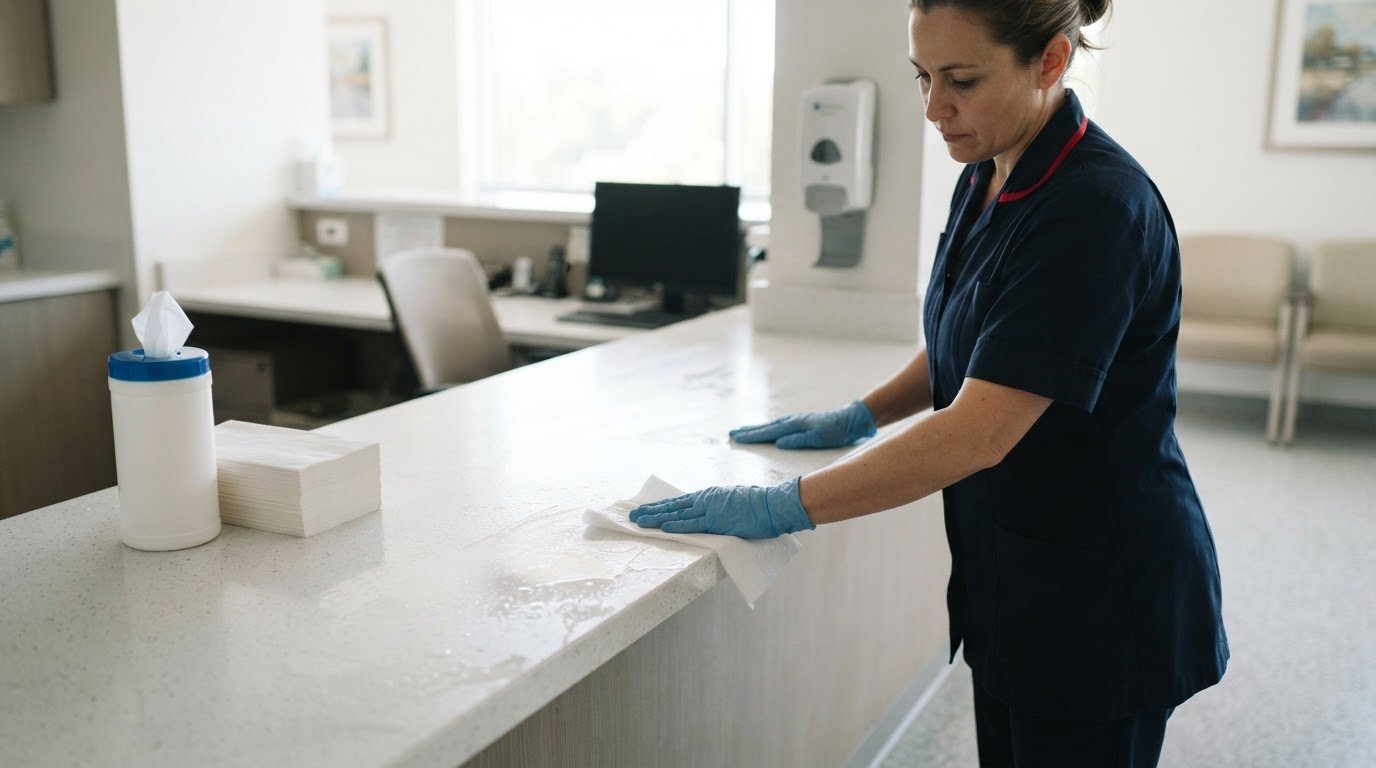
At reception, place hand-hygiene products where staff and visitors can use them. Choose suitable cleaners for counters and frequently touched surfaces, such as lift buttons. Paper towels and disposable tissues can support drying and everyday cleaning tasks. A practical supply plan identifies each surface, the product assigned to it, and the procedure staff follow, keeping surface cleaning distinct from hand hygiene.
Cleaning, Sanitizing, and Disinfecting
Cleaning removes visible soil from a surface. Sanitizing reduces germs to a level considered acceptable for its intended use, while disinfecting uses a product intended to destroy germs on surfaces. These steps serve different purposes, so list supplies by task rather than treating the terms as interchangeable. Follow product directions and the clinic’s procedure for the surface being treated.
Product Comparison and Cleaning Requirements
Compare products by intended use, surface compatibility, directions, and fit with clinic procedures, not by brand name alone. For EPA and CDC requirements, follow applicable product-label directions and facility procedures. A general supply list cannot establish every requirement for every setting. Make sure staff can distinguish cleaners from disinfectants and understand which task each supports. This connects product selection to the clinic’s cleaning protocol.
Supply Use, Storage, and Inventory Risks
Expired products may no longer be suitable for their intended use. Improper storage can affect product condition, and incorrect use can leave surfaces inadequately treated or damage them. Keep supplies in designated storage and follow product directions. Track use and expiration dates, move older usable stock forward, and reorder based on routine consumption. These steps help reduce waste and the risk of shortages.
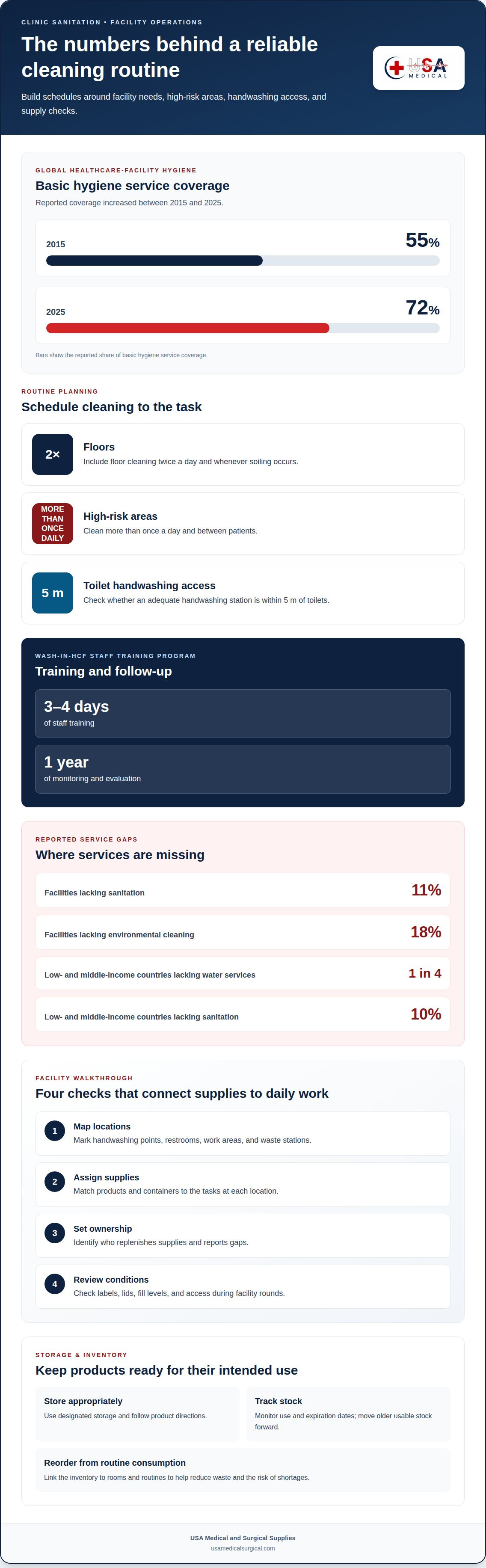
Build environmental cleaning into a written schedule. The facility assessment includes cleaning floors twice a day and whenever soiling occurs. It also checks whether cleaning protocols are in place. High-risk areas require cleaning more than once a day and between patients. Staff training supports consistent use: the WASH-in-HCF staff training program includes 3-4 days of training and 1 year of monitoring and evaluation.
For clinic toilets, provide hand-cleaning products such as soap dispensers and paper towels, alongside products for touchable surfaces. An assessment checks whether an adequate handwashing station is within 5 m of toilets. Include the location and restocking of these supplies in the cleaning routine, so staff can address hand hygiene and surface cleaning as separate tasks.
Healthcare facility sanitation
For a U.S. clinic, sanitation planning starts with mapping the spaces, tasks, and supplies used each day. Mark handwashing points, restrooms, patient rooms, staff areas, and waste collection locations, then assign a routine to each. This makes it easier to see whether staff can access the products and containers they need. Organize healthcare sanitation supplies around these locations instead of storing them as one undifferentiated group.
Plan hand hygiene as a facility function, not just an individual action. Identify where staff, patients, and visitors wash or clean their hands, then list what each point needs. For example, a sink-based station may need soap and a way to dry hands, while a separate dispenser may support hand hygiene elsewhere. Assign responsibility for replenishing each station and recording empty dispensers or missing items.
Restrooms need a coordinated plan for handwashing and facility cleaning. Place hand-cleaning products and paper supplies where they can be used as intended. Include toilet touchpoints, fixtures, and other surfaces in the room’s cleaning routine. A walkthrough can reveal hard-to-reach surfaces, storage problems, and frequently misplaced supplies. Keep instructions specific to each area so staff know what to restock and clean.
Include waste handling in the sanitation plan. Check that waste bins are labeled or color-coded, sharps bins have lids, and containers are not full or overflowing. These checks help staff spot when a bin needs attention before it disrupts work. Place containers according to facility waste procedures, and ensure staff know how to replace or remove them. Keep clean supplies separate from waste-handling materials.
- Map locations: Identify handwashing points, restrooms, work areas, and waste stations.
- Assign supplies: Match products and containers to each location’s tasks.
- Set ownership: Identify who replenishes supplies and reports gaps.
- Review conditions: Check labels, lids, fill levels, and access during facility rounds.
Use the walkthrough to build an inventory linked to actual rooms and routines. Record the items assigned to each location, where they are stored, and who replenishes them. This gives staff a shared reference when work areas change or supplies move. Reviewing the inventory alongside routine observations can reveal recurring gaps and improve ordering decisions. A well-organized healthcare sanitation supplies plan connects purchasing to operational needs instead of relying on memory.
Global healthcare-facility basic hygiene service coverage rose from 55% in 2015 to 72% in 2025; 11% lacked sanitation, 18% environmental cleaning. Low- and middle-income countries: one-quarter lack water services; 10% lack sanitation.
Protective clothing and personal protective equipment
Protective clothing and personal protective equipment support tasks that may involve contact with patients, materials, or cleaning products. The appropriate items depend on the task and the clinic’s procedures. Examples include medical apparel, gloves, gowns, masks, and eye protection. Organize supplies by use so staff can find the items specified for each procedure without confusing them with routine clothing.
Selecting PPE for Clinic Tasks
Start with the task, then identify the protective items specified in the clinic’s procedure. A patient examination, handling used materials, and cleaning a surface may call for different supplies. Keep the categories distinct: gloves, gowns, masks, and eye protection each have a separate role. Review product labeling and intended use when comparing items. A clear selection process helps staff match supplies to the activity instead of relying on one set for every situation.
Use, Change, and Disposal
Staff should follow the clinic’s established procedure for putting on, removing, and disposing of protective items. For example, a procedure may specify gloves for one task and a fresh pair for the next. Handle used items according to the clinic’s waste process, not by returning them to clean supplies. Separate clean stock from used items at the point of work. This makes the distinction visible and helps prevent accidental reuse.
Fit and accessibility affect routine use. Keep commonly used sizes together and label storage areas clearly. Place supplies near the work area where staff need them, such as a designated treatment space, while protecting clean items from splashes and handling. If staff repeatedly reach for an unavailable size or substitute another item, review the procedure and stock arrangement. The goal is a usable setup that reflects actual clinic tasks.
- Before a task: Identify the procedure and gather the listed protective items.
- During a task: Follow the clinic’s instructions for changing or removing items.
- After a task: Dispose of used items through the designated waste process.
- Between tasks: Return only clean, unused supplies to their designated storage area.
Include protective clothing in staff orientation and routine procedure reviews. A walkthrough can show where gloves, gowns, masks, and eye protection are stored and where used items go. Staff can also review task-specific instructions, such as which items are required for a defined cleaning activity. Clear directions reduce guesswork and connect PPE handling to the clinic’s broader infection-control routines.
Keep PPE selection separate from surface-cleaning product selection. Gloves and gowns do not replace cleaning or disinfecting a work area. Staff should follow the relevant procedure for each task, using protective items as directed and cleaning products on their intended surfaces. This distinction helps clinics plan protective clothing and environmental supplies as complementary parts of daily operations.
Disposable towels and paper products
Paper products support specific clinic routines, from drying hands to handling everyday spills. Separate supplies by location and purpose. A kitchen may need paper for hands, tools, and food-contact surfaces, while a staff break area may need napkins and tissues. Assigning products to tasks helps staff find the right item and ties restocking to actual use.
Paper Products by Clinic Area
In staff kitchens, kitchen paper, soap, spray cleaners, and disposable towels can support hand, tool, and food-contact surface cleaning. Canteens can use paper napkins, napkin holders, detergents, and hand gels in dispensers. These products serve different purposes: napkins are for meals, while kitchen paper and towels support cleaning or drying. Keep each product in its designated area so its intended use is clear.
Shared staff rooms also benefit from a defined paper-supply setup. Place napkins near the eating area and tissues where staff can reach them easily. Keep cleaning towels with the relevant cleaning products rather than mixing them with items intended for personal use. Simple labels, such as “break area” or “kitchen cleaning,” make supplies easier to return and replenish.
Dispensers, Placement, and Restocking
Choose storage and dispensers to suit the task and location. A napkin holder keeps meal supplies together, while an antibacterial dispenser can hold hand gel in a canteen. Place paper products near the point of use, but apart from wet cleaning materials. During routine checks, note empty dispensers, damp or damaged paper, and products stored in the wrong area. These visible checks help keep supplies usable.
Inventory works best when each paper item has a clear purpose and storage location. Track kitchen paper, disposable towels, napkins, and tissues separately. If an item serves several tasks, record those uses so replenishment reflects actual demand. Rotate stored stock so older packages are used first, and keep replenishment supplies organized away from active work surfaces.
- Kitchen: Keep kitchen paper, soap, spray cleaner, and disposable towels available for assigned tasks.
- Canteen: Place napkins in holders and hand gel in its designated dispenser.
- Staff room: Separate tissues and napkins from cleaning towels.
- Storage: Label locations and check stock condition during routine restocking.
Paper products are not interchangeable just because they are disposable. A meal napkin, a hand-drying towel, and paper used with a spray cleaner serve different roles. Make these distinctions part of staff instructions. For example, a kitchen routine can specify which product is for hand drying and which is used with cleaning supplies for tools or food-contact surfaces. Clear assignments help prevent misplaced stock and make replenishment more consistent.
What are the differences between cleaning, sanitizing, and disinfecting in healthcare?
Cleaning, sanitizing, and disinfecting describe different steps in surface care. Cleaning removes soil and residue, such as visible material on an examination table. Sanitizing reduces germs to a level considered acceptable for a particular use. Disinfecting uses a product intended to destroy germs on surfaces. Clinic procedures should name the step required for each task rather than use these terms interchangeably.
Start by cleaning a surface with visible soil. Use the method and product specified for that surface, such as a counter or reusable work surface. Dirt and residue can interfere with later surface treatment, so staff should follow the clinic’s sequence before applying another product. Keep the cloth or paper product assigned to cleaning separate from clean supplies.
Sanitizing is a distinct treatment, not simply another word for wiping. A clinic might use a sanitizing product for a surface or setting where that level of treatment is intended. Let the product label and facility procedure guide the choice. Do not assume that a product suitable for one surface or use is also suitable for another. Record the intended use in the procedure so the product has a clear purpose.
Use a disinfectant when the clinic’s procedure calls for disinfecting a surface. For example, a staff member may first clean a frequently touched surface, then apply the designated disinfectant according to its label. Follow the product’s instructions for application and use. Do not replace those directions with a general wiping habit, since products can have different instructions.
A simple decision sequence keeps the three terms clear:
- Identify the surface: Name the item, such as an examination table, counter, or handle.
- Check the task: Decide whether the procedure calls for cleaning, sanitizing, or disinfection.
- Choose the product: Match its labeled use to the surface and task.
- Follow the directions: Apply and handle the product as instructed.
- Document the routine: Record the task and assigned product in the facility procedure.
Train staff using examples from the clinic. A counter with visible residue is a clear cleaning scenario; a procedure calling for disinfection is a separate example of product use. Explain which supplies belong at each work area and where used materials go. During routine reviews, check that written procedures, product labels, and staff instructions use consistent terms. This reduces confusion during daily surface care.
Organize cleaners and disinfectants by intended task, not just by how their containers look. Clear labels and designated storage help staff select the right item. The practical approach is to identify what the surface needs, then follow the matching procedure and product directions.
USA Medical and Surgical Supplies
USA Medical and Surgical Supplies offers Infection Control supplies for clinics organizing sanitation and surface-care routines. Browse the catalog when reviewing supply categories alongside the cleaning, hygiene, and protective procedures described above. Planning by task helps identify which supplies support routine facility needs and keeps diagnostic equipment distinct from environmental cleaning products.
Browse the relevant categories to support your clinic’s purchasing plans. The catalog also includes Blood Pressure Devices, Dopplers, ECG Machines, and ECG Electrodes for other clinical needs.
Contact USA Medical and Surgical Supplies to discuss your clinic’s supply needs.
Build a Routine Your Clinic Can Maintain
Make sanitation planning part of routine clinic operations. Assign responsibility for reviewing supply levels, updating procedure notes, and identifying recurring gaps. A simple record of what each area uses helps purchasing decisions reflect actual needs rather than assumptions. Keep reviews connected to staff workflows so healthcare sanitation supplies support daily tasks without creating a separate, hard-to-maintain process.
Revisit the supply plan when procedures or clinic spaces change. A new treatment area, an updated workflow, or a change in how shared spaces are used may affect what staff need on hand. Keep instructions practical and make supply organization easy to follow. Small, regular reviews help keep routines workable over time.
For help with clinic supply needs, contact USA Medical and Surgical Supplies. Take the next step with a clearer plan and dependable support for your clinic’s operations.
Frequently Asked Questions
What sanitation supplies are essential for healthcare facilities?
Essential supplies depend on the clinic’s spaces and daily tasks. A practical baseline includes hand-hygiene products, surface cleaners, disinfectants selected for their intended use, medical gloves, protective apparel, disposable towels, and waste containers. Keep a location-based inventory so each exam room, restroom, and shared workspace has supplies suited to its routine. This makes gaps easier to spot during restocking and separates environmental cleaning stock from patient-care items.
What disinfectants and cleaning products are approved for healthcare use in the U.S.?
Product suitability depends on its labeled use and the task, not the brand name alone. Review the product label and applicable EPA product information, then compare the stated use with CDC infection-control guidance and facility procedures. The catalog includes examples such as CaviCide, CaviWipes, and PDI Sani-Cloth. Their availability does not mean a specific item suits every surface or clinical task.
What infection-control supplies are needed for patient rooms, operating rooms, and waiting areas?
Supply each area according to its workflow. A patient room may need hand-hygiene products, gloves, medical apparel, and products designated for room surfaces. Operating rooms need supplies aligned with the facility’s procedures for that work area. Waiting areas may need hand-hygiene options and products for shared counters or seating. Organize supplies by location, separating clean stock from items used during a task.
How should healthcare disinfectants be selected and used safely?
Choose a disinfectant by matching its labeled purpose to the surface and cleaning task. Before use, staff should read the product directions, follow the clinic’s written procedure, and use the protective items specified for that task. Store the product as directed and keep its label available to staff. Do not substitute a product intended for another surface just because it is nearby; follow the label and procedure.
What EPA and CDC rules apply to healthcare cleaning and disinfection supplies?
Follow applicable product-label directions and your facility’s procedures. Select products for their intended use, surface compatibility, and the task being performed.