
Clinical Stethoscopes: Acoustic and Electronic Auscultation
10/23/2026 05:16:51

A stethoscope carries internal body sounds to a clinician for assessment. In an acoustic model, sound travels through flexible tubing to the ears. An electronic model captures sound and may convert it into visual data for analysis or sharing. Both support auscultation, but they handle and present sound differently.
Choosing an acoustic or electronic stethoscope depends on what you need to hear and how you use the findings. A familiar acoustic design may suit routine listening, while electronic features can support sound analysis and sharing. Neither replaces clinical judgment or additional tests when a sound needs further investigation.
This guide explains how each stethoscope type works, the diagnostic and monitoring tasks it supports, and which features to compare. You’ll also learn how to assess adult or pediatric use, understand sound amplification and visualization, and choose equipment suited to your clinical setting.
Key Takeaways
- Compare acoustic sensitivity and frequency adjustment to match listening needs with the right equipment type.
- Review length, weight, diaphragm dimensions, and warranty terms when assessing product specifications.
- Consider patient age and the subtlety of sounds when selecting equipment for cardiology or pediatric auscultation.
- Understand how electronic models capture, amplify, visualize, and share sounds before choosing a digital option.
- Match diagnostic and monitoring equipment to the assessment, including when blood pressure devices, Dopplers, or ECG equipment are relevant.
Acoustic sensitivity and frequency adjustment
Acoustic sensitivity describes how clearly a listener hears body sounds. Frequency adjustment helps distinguish lower- and higher-pitched sounds during an examination.
Acoustic Sensitivity
In an acoustic model, sound travels through flexible tubing from the body to the clinician’s ears. Sensitivity describes how clearly those sounds reach the listener. It depends on the instrument’s design and listening conditions. For example, background noise can make subtle sounds harder to distinguish, even with a sensitive model.
The Littmann Classic III allows adjustment between low- and high-frequency sounds, helping clinicians adapt their listening technique to the sound being assessed. A student learning auscultation can practise comparing the same area with different pressure on the chestpiece. The change helps show how frequency emphasis affects what reaches the ears.
In the United States, a person can generally buy an acoustic model without a prescription or professional certification. Owning equipment is different from being qualified to perform clinical assessments or interpret findings.
Before choosing, consider whether the model offers the listening flexibility your work requires. Think about where you’ll use it, too: faint sounds are easier to hear in a quiet room than in a busy clinical environment. Fit, handling, and a secure seal at the eartips also affect the listening experience.
Acoustic Performance Ratings
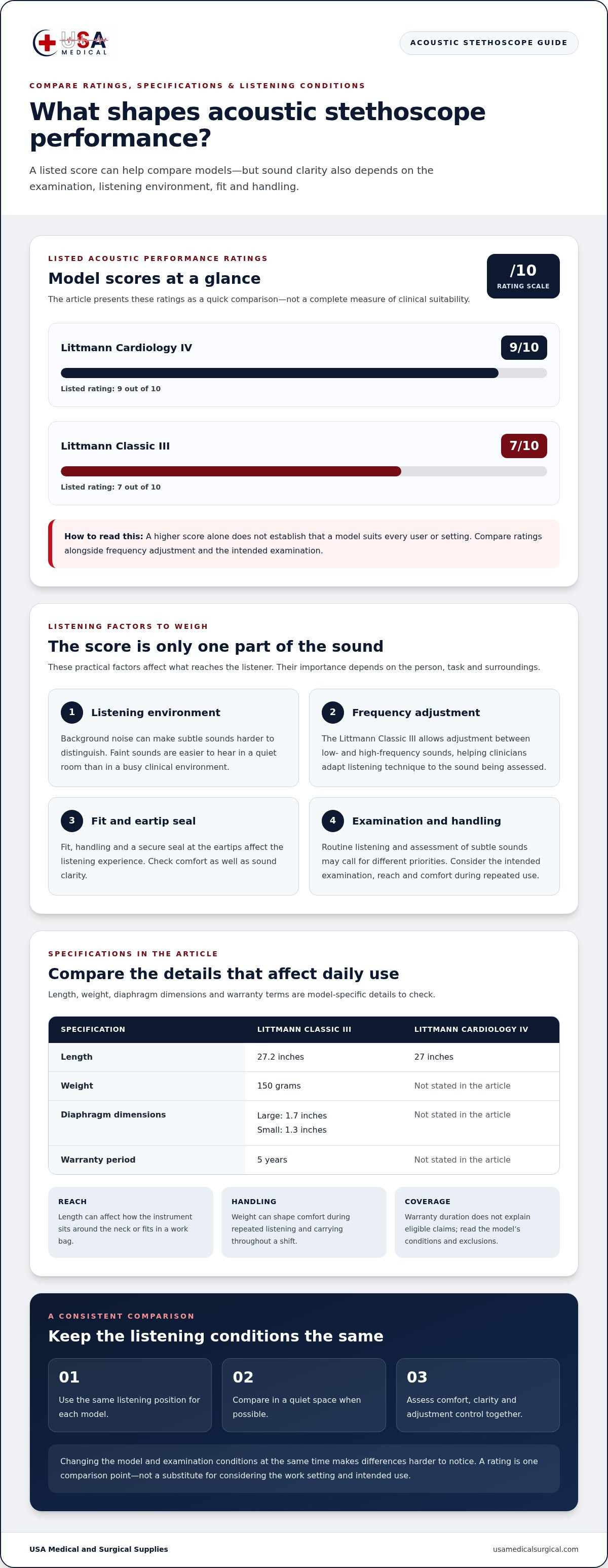
Acoustic performance ratings offer a quick comparison, not a complete measure of clinical suitability. The listed rating for the Littmann Classic III is 7 out of 10, while the Littmann Cardiology IV is rated 9/10. These scores can help narrow choices, but they don’t explain every factor that shapes sound in practice.
Compare ratings alongside frequency adjustment and the intended examination. A higher score alone doesn’t establish that a model suits every user or setting. For example, someone prioritizing routine listening may weigh handling and frequency control differently from someone assessing subtle sounds in challenging conditions.
Care also helps preserve acoustic performance. After use, clean the chestpiece and other parts according to the manufacturer’s instructions. Avoid methods that could damage the tubing or finish. Check the eartips and tubing for visible wear, then store the instrument in a clean, dry place where it won’t be bent or crushed.
For a practical comparison, listen in a quiet space and assess comfort, sound clarity, and adjustment control. Use the same listening position for each model. This makes differences easier to notice than changing models and examination conditions at the same time.
Product specifications and warranty
Dimensions, weight, and warranty terms affect daily use and ownership. Compare each model’s specifications with your listening needs and work setting before selecting a stethoscope.
Product Specifications
Start with length and weight. The Littmann Classic III is listed at 27.2 inches and 150 grams. Its large diaphragm measures 1.7 inches, while its small diaphragm measures 1.3 inches. These details help professionals assess reach, handling, and chestpiece size for different patients.
Compare models in context. The 3M Littmann Cardiology IV is 27 inches long. A model’s length can affect how it sits around the neck or fits into a work bag. Weight also shapes comfort during repeated listening, especially when a clinician carries the instrument throughout a shift.
Check the exact model name and listed specifications before purchase. Similar product names can refer to different versions, so match the description to the instrument you need. For example, confirm that the listed dimensions and chestpiece configuration suit your examination tasks and storage routine.
Consider practical handling, too. If several professionals share equipment, consistent identification and a clear storage location can reduce mix-ups. For individual use, consider where you’ll carry the instrument between examinations and whether its length and weight feel manageable.
Warranty Durations
Warranty duration identifies the period stated for coverage, not the condition of every component. The Littmann Classic III has a listed warranty period of 5 years. Treat that as a model-specific detail, rather than assuming another model or brand has the same term.
Before buying, record the model name and its stated warranty period. Keep purchase documentation and warranty terms with your equipment records. These details make it easier to identify the product and understand which terms apply if an issue arises during the stated period.
Duration alone doesn’t explain which claims are eligible. Read the warranty alongside its conditions and exclusions. For example, distinguish a manufacturing issue from wear or accidental damage according to the written terms for that instrument.
Warranty Coverage
Coverage terms explain which issues qualify and what remedy may apply. They can vary by model and manufacturer. Read the exact warranty language for the instrument you’re considering; the 5-year Littmann Classic III period does not, by itself, explain what its warranty covers.
Keep warranty questions separate from repair needs. A warranty applies under its stated conditions, and it doesn’t mean every worn or damaged part qualifies. Note the model and describe the issue clearly before following the manufacturer’s warranty instructions.
Routine care helps keep equipment ready for use. Clean the chestpiece and tubing according to the manufacturer’s instructions, inspect for visible damage, and store it without crushing or sharply bending the tubing. To compare available clinical listening equipment, review the listed specifications alongside your work needs.
Cardiology and pediatric auscultation
Auscultation helps clinicians assess internal body sounds in cardiology and pediatric settings. Listening findings provide information, but they don’t establish every diagnosis.
Uses in Auscultation
Healthcare providers use a stethoscope to listen to sounds from the heart, lungs, intestines, and blood vessels. Each location offers a different part of the clinical picture. For example, listening over the chest can reveal heart or lung sounds, while abdominal listening focuses on intestinal sounds.
Let the examination’s purpose guide equipment selection. Cardiology work may prioritize listening for subtle heart sounds. General examinations can involve several body areas, so practical handling matters across repeated placements. A stethoscope used for varied assessments should suit the clinician’s routine and the patients being examined.
Clinical Use and Auscultation Skills
Good listening depends on a consistent method. Place the chestpiece at the intended site, limit clothing or movement noise, and listen before moving to another location. During a heart examination, compare listening points systematically rather than relying on a single contact position.
Clinical skill also involves interpreting sounds in context. An abnormal sound can prompt further assessment, but additional tests may be needed to identify the problem and its seriousness. Auscultation is one part of an evaluation, not a substitute for the full clinical process.
Cardiology equipment may be designed for adult and pediatric examinations. The Littmann Cardiology IV is designed for auscultation of adults and pediatric patients. Its intended patient groups may make it relevant for clinicians working across different care settings.
Pediatric listening calls for attention to patient comfort and chestpiece placement. A child may move or become unsettled during an examination, so a calm, clear sequence can help. Prepare the stethoscope first, explain the next step simply, and keep each listening position deliberate.
The listening environment matters in cardiology. Background conversation, equipment noise, and interruptions can compete with quiet body sounds. Where possible, reduce distractions before beginning. This helps clinicians focus on the sound instead of repeatedly repositioning the chestpiece.
Auscultation can cover more than one body system during an assessment. For example, a provider may listen to the heart and lungs, then assess intestinal sounds. Keep the sequence organized and note where each finding occurs. If an unexpected sound is heard, repeat the listening position and consider the broader examination findings.
Use findings carefully. A sound may be abnormal without revealing its cause or seriousness on its own. Further testing can help clarify what the listening exam suggests. The Littmann Cardiology IV’s adult and pediatric design supports examinations across those patient groups, while listening technique and the wider clinical assessment guide interpretation.
Digital stethoscopes
Digital models capture body sounds electronically rather than relying only on acoustic transmission through tubing. Depending on the model, their features can support amplification, visual review, and sharing.
The first stethoscope designed to work with a smartphone application was introduced in 2015. Digital systems can convert captured sounds into visual data. Providers can download and analyze those recordings or share them with other providers. This creates a different listening workflow from a classic acoustic model, where sound travels through flexible tubing to the ears.
A practical digital workflow starts by positioning the chestpiece and capturing the sound. The provider then listens to the recording or reviews its visual representation. If collaboration is needed, the recorded data can be shared. This can help when a second provider needs to review the same captured sound rather than rely only on a spoken description.
Amplification and noise cancellation are separate functions. Amplification raises the captured sound level; noise cancellation aims to reduce unwanted noise. A higher amplification figure alone doesn’t show how well a device handles interference. For example, the Littmann CORE Digital Stethoscope amplifies sound up to 40x at peak frequency compared with an analog stethoscope. That figure describes peak-frequency amplification, not a guarantee of noise removal.
Background noise still matters during use. A busy room can introduce sounds that compete with a patient’s heart or lung sounds. Position carefully, reduce avoidable noise, and listen to the captured result before relying on it. These steps help distinguish a useful recording from one dominated by movement or surrounding activity.
Comfort remains part of the selection process. Compare the chestpiece and tubing, and consider how the device sits during a typical examination. A digital interface may add steps, so consider whether recording, playback, or sharing fits the clinical routine. An acoustic model may feel more direct for professionals who prefer listening without a digital workflow.
Choose features to suit the intended use. A provider who needs to review or share recordings may value visual data and download options. Someone focused on direct auscultation may prioritize familiar handling and a clear acoustic pathway. Compare amplification claims with the specific task, and treat noise reduction as a separate capability rather than assuming it comes with digital sound capture.
Captured sounds can also be downloaded for analysis or sharing with other providers.
Diagnostic and monitoring stethoscopes
Diagnostic listening supports assessment, while monitoring focuses on observing sounds over time or during care. The right instrument depends on the sounds being assessed, the setting, and the clinician’s workflow.
Healthcare providers use a stethoscope to listen to the heart, lungs, intestines, and blood vessels. Each listening location serves a different purpose. For example, chest auscultation can help identify unusual heart or lung sounds, while abdominal listening focuses on intestinal activity. The diaphragm contacts the body and transmits sound through the instrument. Clinicians choose placement according to the body area and question they’re assessing.
Diagnostic models differ in how they handle subtle sounds and challenging environments. The Littmann Cardiology IV is designed to isolate subtle sounds of health changes in challenging environments. This feature is relevant when a clinician needs to focus on faint details amid competing noise. It doesn’t make a sound a diagnosis by itself. Unusual findings may require additional tests to clarify the problem and its seriousness.
Monitoring can also involve specialized designs. A military noise-immune Doppler stethoscope has been developed for auscultation in sound environments up to 110 dB. This example shows how operating conditions can shape equipment design. It isn’t the same as assuming every monitoring instrument provides noise immunity. Match the device’s stated purpose to the listening environment and task.
Intraoperative monitoring has its own history. The esophageal stethoscope was part of routine intraoperative monitoring before the 1960s. This context illustrates that listening tools can be adapted for particular clinical procedures. For present-day selection, distinguish general diagnostic listening from equipment intended for specialized monitoring, and consider how the instrument fits into the broader assessment process.
Start a practical comparison with three questions: which body sounds need assessment, where will listening take place, and does the task involve a routine examination or a specialized setting? A diaphragm’s contact area and the instrument’s sound transmission affect handling and listening. For example, a clinician assessing several body systems may prioritize versatile use, while a demanding environment may call for a design intended to isolate subtle sounds.
Keep interpretation grounded in context. A detected sound can guide the next assessment step, but listening alone may not identify its cause or seriousness. Pair auscultation with the appropriate clinical evaluation and other diagnostic findings. To compare equipment for clinical workflows, explore diagnostic equipment suited to your assessment needs.
USA Medical and Surgical Supplies: Blood Pressure Devices
USA Medical and Surgical Supplies offers diagnostic equipment to complement clinical auscultation. For assessments that include blood pressure readings, its Blood Pressure Devices are a relevant equipment category to consider alongside a listening tool.
Other available options include Dopplers, ECG Machines, and ECG Electrodes. These serve different diagnostic tasks, so select equipment according to the measurements or recordings required in your clinical workflow. Choosing suitable categories supports a more complete setup without treating any single device as a substitute for clinical assessment.
Visit usamedicalsurgical.com to explore equipment options or contact USA Medical and Surgical Supplies.
Build the right equipment setup for your next step
Use your clinical workflow to guide your next equipment decision. Consider what you need to listen to, measure, or record, and how each tool fits alongside the others. A stethoscope supports auscultation, while other devices serve different assessment needs. Keeping those roles clear helps you plan a practical setup without expecting one instrument to do every job.
USA Medical and Surgical Supplies offers Blood Pressure Devices, Dopplers, and ECG Machines for these distinct clinical tasks. Review the equipment categories that match your requirements, then choose the next step that fits your workflow.
Contact USA Medical and Surgical Supplies to discuss your equipment needs. A considered selection can help you move forward with a setup suited to your work.
Frequently Asked Questions
How does a stethoscope work?
An acoustic stethoscope carries body sounds through its chestpiece and tubing to the listener’s ears. The chestpiece picks up vibrations at the contact point, and the tubing conveys them through the earpieces. Electronic models capture sounds and process them electronically. Depending on the model, clinicians may listen to the sound, view sound data, or share a recording for review.
What are the different types of stethoscopes?
The main types are acoustic and electronic models. Acoustic versions transmit sound mechanically, while electronic versions capture and process it digitally. Specialized designs serve particular environments or monitoring tasks. For example, Doppler stethoscopes can be designed for listening in noisy settings, and esophageal models have been used in intraoperative monitoring. Choose according to the intended task, listening environment, and preferred workflow.
Who invented the stethoscope?
French physician René Laennec invented the first stethoscope in 1816. Arthur Leared later created a binaural version in 1851, allowing listening through both ears. Somerville Scott Alison described his stethophone invention at the Royal Society in 1858. These developments show how the instrument evolved from an early listening tool into designs supporting different clinical uses.
What is a stethoscope and how does it work?
A stethoscope is a clinical listening instrument used during physical examinations. Its chestpiece contacts the body, and the sound pathway carries vibrations to a clinician for listening. Electronic versions add sound capture and processing. In practice, the instrument helps clinicians assess internal sounds as one part of an examination. What they hear must be interpreted alongside other clinical findings.
What types of stethoscopes are available, including acoustic and electronic?
Acoustic and electronic models are the broad categories. Acoustic instruments send sound directly through tubing, while electronic models capture sounds for listening or further review. Some electronic options support visualization, downloading, analysis, or sharing. Specialized Doppler designs address particular listening environments. Compare how each option handles sound and whether its workflow suits the examination setting and users.
How do you use a stethoscope to listen to heart and lung sounds?
Place the chestpiece against the intended area and listen in a quiet setting. For a basic examination, clinicians move between selected chest locations, listening for heart sounds and then lung sounds. Keep the chestpiece steady and avoid rubbing it against clothing, which can create distracting noise. Clinical training guides placement and interpretation; sounds alone don’t establish a diagnosis.
What are common stethoscope problems and how can you troubleshoot them?
Common listening problems include muffled sound, loose eartips, obstructed tubing, or noise from movement and clothing. Check that the eartips fit securely and the chestpiece is set to the intended side. Inspect the tubing for visible damage, then test the instrument in a quiet room. Clean and store it according to the manufacturer’s instructions. Persistent faults may require professional assessment.
How much does a stethoscope cost in the United States?
Cost varies by model and features.